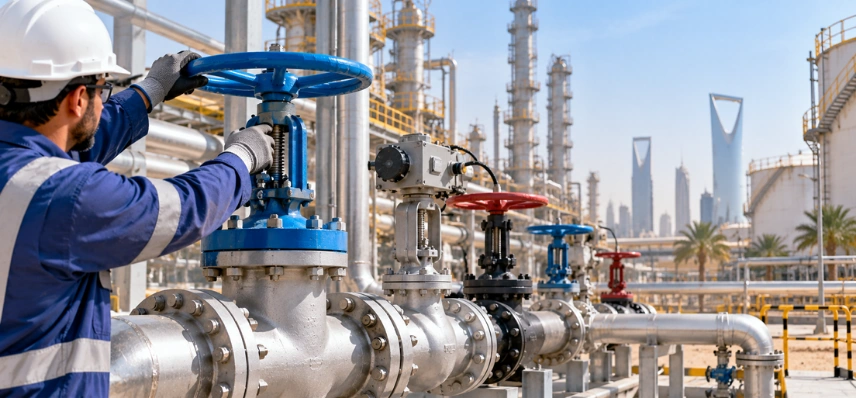
Industrial valves play a critical role in controlling the flow, pressure, direction and isolation of liquids and gases across industrial systems. From oil and gas facilities to manufacturing plants, water treatment systems, construction projects and power facilities, the right valve can make a significant difference in operational efficiency and safety.
For businesses operating in Saudi Arabia, selecting suitable industrial valves requires careful consideration of the application, operating conditions, pipeline requirements and environmental factors. This guide explains the main types of industrial valves, their applications and what to consider when choosing the right valve for your project.
An industrial valve is a mechanical device used to start, stop, regulate, or redirect the flow of fluids or gases through a piping system. Depending on the design, valves can provide simple on/off isolation or precise flow control.
Industrial valves are commonly used in:
Because different industries operate under different pressures, temperatures and fluid conditions, choosing the correct valve is essential for reliable performance.
Different valve designs are suited to different applications. Understanding their basic functions can help businesses make better purchasing decisions.
Ball valves use a rotating ball with a central opening to control fluid flow. They are widely used for quick shut-off and isolation applications.
Their compact design and relatively simple operation make them suitable for various industrial piping systems.
Butterfly valves use a rotating disc to regulate or stop flow. They are often selected for applications where space, weight and efficient flow management are important.
They can be used in water systems, industrial pipelines, HVAC applications and other fluid-handling systems.
Gate valves are primarily designed for full-flow or shut-off applications. When fully open, the gate moves away from the flow path, allowing fluid to pass through the pipeline.
They are commonly used in pipelines where the valve generally remains either fully open or fully closed.
Globe valves are designed for controlling and regulating fluid flow. Their construction allows operators to adjust flow more precisely compared with valves intended mainly for isolation.
They can be useful where flow regulation is an important part of the system.
Check valves allow fluid to move in one direction while helping prevent reverse flow. They are commonly installed in piping systems where backflow could affect equipment or system performance.
The correct check valve depends on factors such as flow direction, pressure and installation requirements.
Industrial facilities in Saudi Arabia operate across a wide range of demanding environments. High temperatures, industrial workloads, challenging operating conditions and different fluid-handling requirements can all influence valve selection.
A valve that works well in one application may not be suitable for another. Businesses should therefore consider:
Selecting the appropriate valve can help support system reliability, operational efficiency and long-term maintenance planning.
Before purchasing an industrial valve, start by understanding the application.
First, identify the fluid. Water, oil, chemicals, steam and gases can require different valve materials and designs.
Next, check pressure and temperature. The valve should be suitable for the system's expected operating conditions.
Consider the required function. Do you need simple isolation, flow regulation, backflow prevention, or another specific function? This will help narrow down the appropriate valve type.
Check pipeline size and connection type. Valve dimensions and end connections must be compatible with the existing piping system.
Finally, consider maintenance and service requirements. A suitable valve should not only perform effectively when installed but also be practical to inspect, maintain and replace when necessary.
Industrial valves are used throughout Saudi Arabia's diverse industrial sectors, from oil and gas to water treatment, chemicals, manufacturing and infrastructure.
In oil and gas, valves can be used for controlling and isolating fluid flow throughout piping and processing systems.
In water and wastewater applications, valves help manage water flow, isolation and distribution.
In chemical industries, valve selection becomes especially important because materials must be compatible with the fluids being handled.
In manufacturing facilities, valves can support process systems, utilities and fluid-handling applications. For construction and infrastructure projects, valves may be incorporated into water, HVAC, fire protection and other mechanical systems.
The quality of the supplier is just as important as the valve itself. Businesses should look for an industrial valve supplier that understands different applications and can provide suitable product options based on project requirements.
Before placing an order, consider the supplier's:
For large industrial projects, it is also useful to provide the supplier with detailed information about valve size, pressure rating, temperature, fluid type, connection requirements, and intended application.
Industrial valves may be small components within a large industrial system, but their role is essential. The right valve can help control flow, isolate equipment, prevent reverse flow, and support the reliable operation of piping systems.
For industries in Saudi Arabia, valve selection should be based on application requirements rather than price alone. Understanding valve types, operating conditions, materials, and system requirements can help businesses make more informed purchasing decisions.
Looking for industrial valves for your next project in Saudi Arabia? ARMC Group provides industrial supply solutions for businesses and industrial applications. Contact the team to discuss your requirements and identify a suitable valve solution for your application.